Short answer
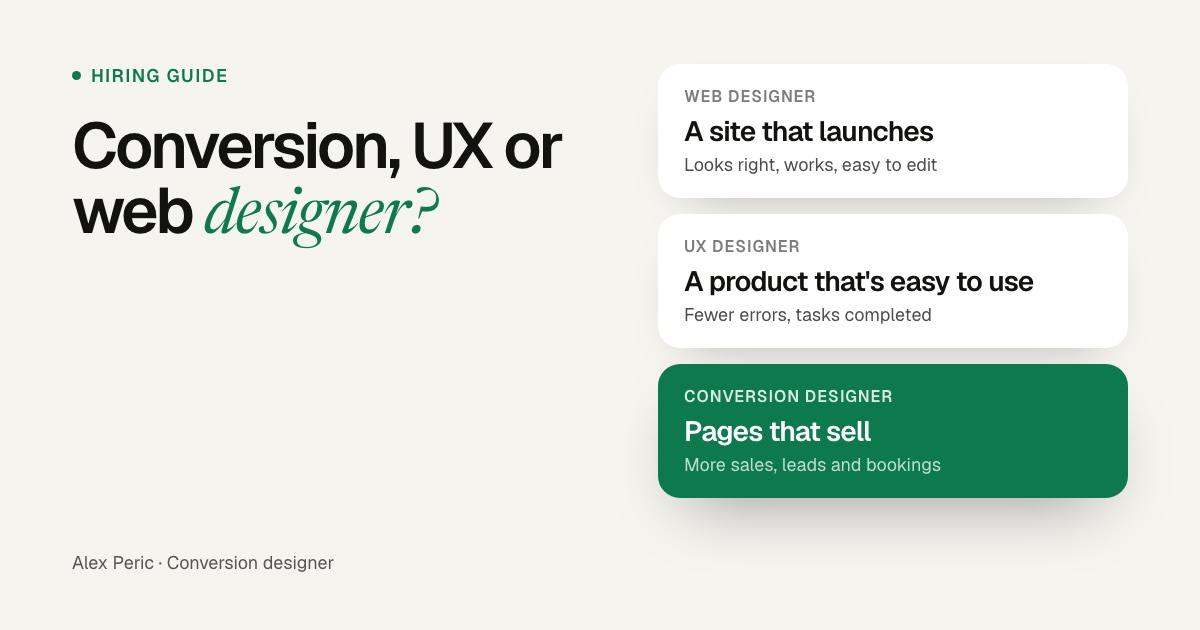
Hire a web designer when you need a new website that looks right and works, a UX designer when you're building a product or app that people need to find easy to use, and a conversion designer when you have traffic but too few visitors buy, sign up or book, and you want pages designed and tested to change that number.
Key takeaways
- A web designer builds the site, a UX designer makes a product easy to use, a conversion designer makes pages sell.
- The biggest difference is how success is measured: a launched site, a product that's easy to use, or more sales and leads.
- Conversion designers start from your analytics, recordings and reviews, and write the copy with the layout.
- The roles overlap. Ask what the person delivers and how they'll measure it, not only what their title says.
- Traffic that doesn't convert? Start with a conversion designer. Need a new site too? Find one who also builds.
Designer job titles overlap, and three get mixed up most when you're hiring for a website: web designer, UX designer and conversion designer. All three design screens. They differ in what they're responsible for, what they start from and how they know the work succeeded. I work as a conversion designer and also design and build whole websites, so this is how I explain the difference to clients.
Conversion designer vs UX designer vs web designer at a glance
| Web designer | UX designer | Conversion designer | |
|---|---|---|---|
| Main job | Design and build a website that looks right, works and is easy to update | Make a product or app easy and pleasant to use | Get more visitors to buy, sign up or book |
| Usually works on | Whole websites: brand sites, company sites, portfolios | Apps, SaaS products, dashboards, complex flows | Websites, product pages, landing pages, pricing, signup and checkout |
| Starts from | The brand, the content and a sitemap | User interviews, usability tests and task flows | Analytics, recordings, heatmaps, customer reviews and the offer |
| Writes the copy | Usually not: the client or a copywriter supplies it | Interface text (UX writing) | Yes, copy and layout together |
| Success means | A site launched on time and on brand | Tasks completed, fewer errors, happier users | Higher conversion rate, revenue per visitor or leads |
| After launch | Updates and maintenance | More research and iterations | A/B tests and the next round of changes |
| Hire when | You need a new site, or yours is dated | You're building or fixing a product's experience | You have traffic but too few customers |
What a web designer does
A web designer plans and designs a website's pages and often builds it too, in WordPress, Webflow, Framer or code. You get a site that looks right, works on phones and is easy for your team to edit. The brief is usually a brand, a list of pages and a launch date.
Good web designers care about conversion, but many don't get the data or the time to check what happens after launch. The work is usually judged on launch day: does it look good, and does it work?
What a UX designer does
A UX (user experience) designer makes a product easy to use. They research how people do a task, map the flow, test prototypes with real users and remove the points where people get stuck. Most UX work happens inside products: apps, SaaS dashboards, onboarding and settings.
UX designers measure success in tasks completed, errors and satisfaction. Those matter on a marketing site too, but a page can be perfectly easy to use and still not persuade anyone to buy.
What a conversion designer does
A conversion designer designs the pages where visitors decide: homepages, product pages, landing pages, pricing pages, signup and checkout. The job is to move a business number, so the work follows four steps:
- Find the leak. Analytics, recordings, heatmaps and reviews show where visitors drop off and what they needed to see.
- Plan the fix. Each change is written as a hypothesis: because we saw X, changing Y should improve Z.
- Design and build it. Copy and wireframe first, then the design for mobile and desktop, then the build.
- Test and learn. The new page runs against the old one, and the result is read in sales or leads.
A conversion designer uses UX skills (clear flows, less friction) and web design skills (layout, type, the build), and adds two more: persuasion, meaning what the buyer needs to hear and in what order, and measurement. You'll also see the role called a CRO designer. It's the same job. More detail in the conversion design process.
Where the roles overlap
The lines are blurry. Many web designers think about conversion, some UX designers work on marketing sites, and a conversion designer who also builds can do a web designer's job on a redesign. So look past the title and ask what the person delivers and how they'll measure it.
Quick check
Which designer do you need? Tick what's true
Questions to ask any designer before you hire
- What will you deliver? Designs, a live site, or both.
- What do you look at before you start designing? Look for analytics, recordings and customer reviews, not only a mood board.
- Who writes the copy? On a sales page, the words do most of the selling.
- How will we know it worked, and when? A number and a date, not "it'll look better".
- Can I see before and after examples with results? And how each result was measured.
- What happens after launch? Maintenance only, or tests and the next round of changes.
Where I fit
I'm a conversion designer. I started at an A/B testing agency designing test variants, then worked in-house and now freelance. I design and build whole websites as well as single product and landing pages, so a client who needs a new site and better conversion doesn't have to hire twice. These are the results of my redesigns that were A/B tested:
Results of my A/B-tested redesigns
Main result of each redesign against the original page. Each one ran as an A/B test. Not shown: the made-to-order oxfords page, where the goal was a drop (−21.3% cancellations before shipping).
Show the numbers as a table
| Item | Value |
|---|---|
| Solar Installer (leads) | +57.3% |
| Dental Implant Practice (consultation requests) | +41.8% |
| HVAC Company (booked visits) | +27.4% |
| Proposal Software (trial starts) | +19.8% |
| Salon Software (demo bookings) | +16.8% |
| Men's Face Wash (revenue per visitor) | +16.1% |
| Interactive Proposals (trial starts) | +14.2% |
| Product Adoption SaaS (demo requests) | +12.6% |
| Small Business CRM (trial starts) | +12.1% |
| Seafood Subscription (subscriptions started) | +11.7% |
| Cast Iron Skillet (conversion rate) | +10.4% |
| Custom Pillow (conversion rate) | +9.2% |
| Spore Probiotic (subscription conversion rate) | +8.6% |
| Air Purifier (revenue per visitor) | +8.2% |
| Golf Irons (conversion rate) | +8.1% |
FAQ
Is a conversion designer the same as a UX designer?
No. A conversion designer uses UX skills, but the goal is different: a UX designer makes a product easy to use, while a conversion designer makes pages persuade visitors to act and measures the result in sales or leads.
Is a conversion designer the same as a CRO designer?
Yes. Both titles describe a designer who specializes in conversion rate optimization (CRO).
Can a web designer do conversion design?
Some can. Ask how they decide what goes on each page, whether they write the copy and how they measure results after launch. If the answers are about looks and launch dates, it's web design.
Do I need a UX designer for my marketing website?
Usually not on their own. A marketing site needs clear UX, but the bigger wins tend to come from what the page says and shows. For an app or a product, a UX designer is the better hire.
Should I hire a conversion designer for a new website?
If the site has a sales or lead goal, yes. A conversion designer who also builds plans each page around its next step, so the new site launches with a reason behind every section, not only a new look.

Conversion designer. I design and build product pages, landing pages and websites, A/B test them and show what each change earned. CXL certified in Conversion Optimization and Ecommerce Marketing, and a guest speaker at NYU School of Professional Studies.